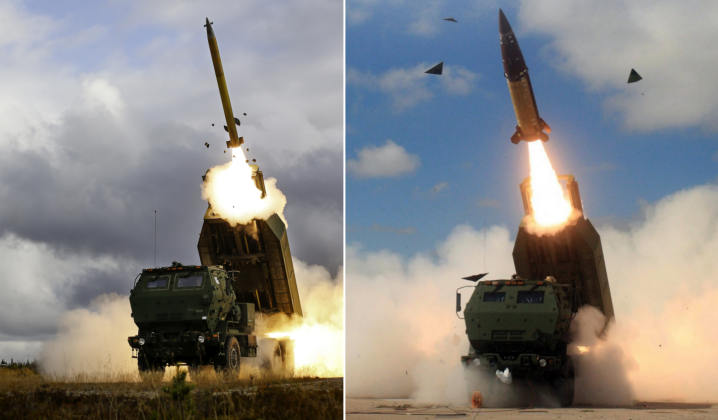
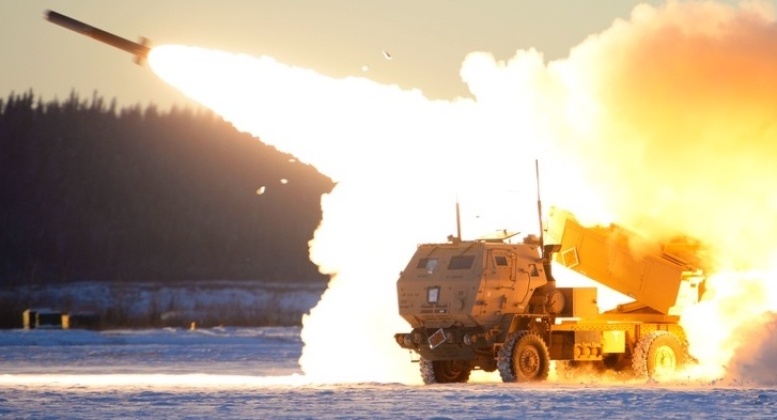
The U.S. Army has deployed M142 High Mobility Artillery Rocket System (HIMARS) artillery units for live-fire exercises near Klaipeda, Lithuania, firing three rockets out to sea in a joint exercise with the Lithuanian Armed Forces. The choice of location, approximately 50 kilometres from the Russian border, was widely interpreted as a show of force. This closely coincides with multiple other deployments of U.S. military assets near Russian’s European borders for both exercises and operations, including the deployment of M1A2 Abrams tanks to participate in Winter Camp exercise approximately 100 kilometres from the Russian border, which occurred on the same day. The slow and steady strengthening in the Baltics is a clear warning to the regime in Moscow by NATO.
Two days prior the Army deployed M2A3 Bradley Fighting Vehicles live fire exercise at Poland’s Bemowo Piskie Training Area, located approximately 60 kilometres from Russia’s borders. The U.S. Navy has also deployed a P-8A Poseidon maritime patrol aircraft to flying extended reconnaissance patterns near Russian controlled territory in the Black Sea.
HIMARS in Lithuania are capable of striking targets across Russia’s Kaliningrad region, and can do so even using lower calibre 277mm artillery rockets rather than more costly longer ranged ballistic missiles. The defences of Russian forces in Kaliningrad have remained under considerable pressure, with HIMARS deployments, and the sales of the systems to Lithuania and Poland, having been significant contributors. In mid-January U.S. Army and Lithuanian Army artillery units conducted advanced interoperability training centred on employment of the HIMARS at the Pabrade training area near NATO’s border with Belarus. The exercises focused on synchronised long-range precision fires, digital command and control procedures, and rapid mobility concepts, which are critical to the United States’ rotational force posture in the Baltic region.
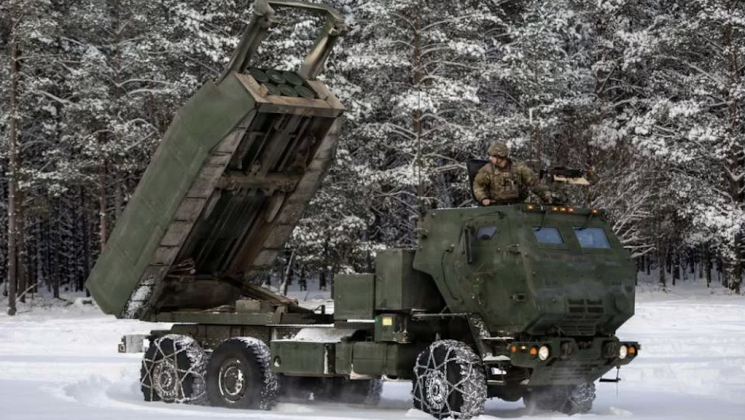
Rocket artillery systems have played a particularly central role in the Russian-Ukrainian War, with HIMARS having achieved multiple notable successes including destroying critical infrastructure, launchers and radars from S-400 air defence systems, ballistic missile launchers, and other high value targets far behind enemy lines. One of the most notable successes achieved in the theatre was a strike on January 1, 2023, which killed 89 Russian military personnel after hitting a temporary barracks in the disputed Donetsk region. Although the HIMARS’ firepower is significantly more limited than other rocket artillery systems fielded by NATO members, such as the M270 and Chunmoo, it is nevertheless highly valued for compressing long-range strike capabilities into a 6×6 truck-sized footprint. This provides speed and high cross-country mobility to improve survivability, while also allowing it to be easily redeployed in numbers by air.