A confidential assessment, circulating as President Donald Trump begins his highly anticipated trip to Beijing, shows shifts in several key areas of competition.
A classified U.S. intelligence assessment has concluded that China is using the ongoing conflict with Iran to strengthen its strategic position against the United States across military, economic, diplomatic, and informational fronts, according to two U.S. officials familiar with the report.
The analysis, prepared this week for Chairman of the Joint Chiefs of Staff Gen. Dan Caine, has heightened concerns within the Pentagon over the broader geopolitical consequences of Washington’s confrontation with Tehran as President Donald Trump begins critical talks with Chinese President Xi Jinping in Beijing.
Compiled by the Joint Staff’s intelligence directorate, the report applies the “DIME” framework — diplomatic, informational, military, and economic instruments of national power — to evaluate Beijing’s response to the war.
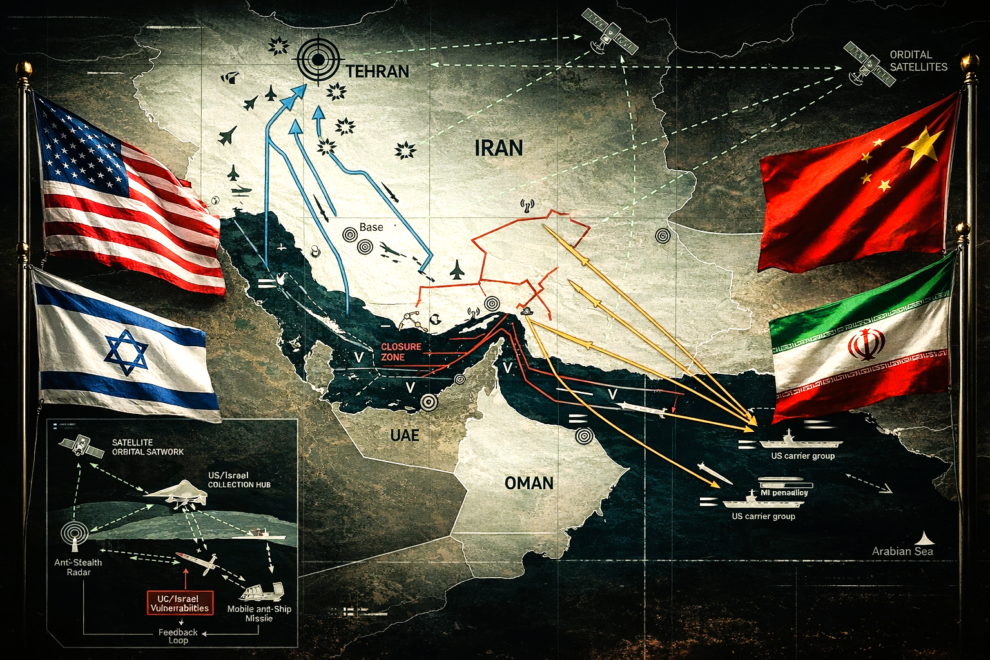
According to the officials, who spoke anonymously because of the sensitivity of the intelligence, the report argues that China has capitalized on the conflict in several ways since the United States and Israel launched military operations against Iran on Feb. 28.
The assessment says China has supplied weapons to Persian Gulf nations aligned with Washington as they attempted to defend oil facilities and military bases from Iranian missile and drone attacks. Beijing has also reportedly expanded energy assistance to countries struggling with shortages after Iran closed the Strait of Hormuz, through which roughly one-fifth of the world’s oil and gas supplies normally pass.
The report further warns that the war has depleted large quantities of U.S. munitions that would be essential in a possible future confrontation with China over Taiwan. In addition, the conflict has allowed Beijing to study American military tactics, operational planning, and battlefield logistics in real time.
On the diplomatic and informational front, the intelligence analysis says China has framed the war as “illegal” in its public messaging, using global criticism of the conflict to undermine America’s image as a defender of the international rules-based order.
Pentagon spokesman Sean Parnell rejected suggestions that the balance of power is shifting away from the United States, calling such claims “fundamentally false.”
White House spokeswoman Olivia Wales defended the administration’s handling of the conflict, saying the United States had severely weakened Iran’s military capabilities and imposed one of the most effective naval blockades in modern history.
China, meanwhile, denied exploiting the crisis. Embassy spokesperson Liu Pengyu said Beijing remains committed to promoting peace and preventing further escalation.
Analysts say the report highlights growing concern in Washington that the conflict may ultimately benefit Beijing more than the United States.
“On balance, the war in Iran is massively improving China’s geopolitical position,” said Jacob Stokes, a senior fellow at the Center for a New American Security.
The report comes at a delicate moment, as Trump seeks to stabilize relations with China during meetings in Beijing that had originally been delayed because of the war.
Despite concerns about economic disruption and global instability, Trump dismissed suggestions that he needs Chinese assistance to resolve the crisis. Before departing for Beijing, he told reporters the United States would prevail “peacefully or otherwise.”
The intelligence assessment also challenges assumptions about China’s vulnerability to energy shortages. While Trump has argued that the closure of the Strait of Hormuz would hurt China because of its dependence on Gulf oil, the report notes that Beijing has weathered the disruption through large strategic reserves and heavy investment in renewable energy.
Ryan Hass, a China expert at the Brookings Institution, said China is using the crisis to expand its influence abroad by offering fuel supplies and green-energy partnerships to countries facing shortages.
“This is not altruism,” Hass said. “It is Beijing seizing on an opportunity to drive wedges between America and its traditional partners.”
The war has also intensified concerns over U.S. weapons stockpiles. American forces have used significant numbers of Patriot missiles, THAAD interceptors, and Tomahawk cruise missiles to defend allies and strike Iranian targets.
That has raised anxiety among Taiwan, Japan, and South Korea about Washington’s readiness to respond to a future Chinese attack.
According to analysts, the shortages could also strengthen voices within Taiwan that oppose increased military spending, potentially weakening deterrence against Beijing.
At the same time, China has used the conflict to portray the United States as an aggressive power trapped in costly Middle East wars while presenting itself as a more stable global actor.
As Stokes put it, Beijing now has an opportunity to depict Washington as “an aggressive, unilateralist power in decline.”