Surrender and Survive
London (20/2). Russia’s February 2022 full‑scale invasion of sovereign Ukrainian territory, marketed domestically as a harmless “Special Military Operation,” as though it were a bureaucratic reshuffling rather than a continental war—has aged poorly for the Kremlin. What was envisioned as a swift decapitation strike against a former satellite state has metastasized into a grinding, attritional conflict reminiscent of the First World War: trenches, mud, artillery duels, and the slow, meat‑grinder logic of industrial warfare.
As the conflict drags into its fourth year, the war has already outlasted the Wehrmacht’s invasion of the Soviet Union—an uncomfortable historical comparison for a regime that trades heavily on the mythology of the Great Patriotic War. Whatever Vladimir Putin imagined in early 2022, it was not this.
A Growing Tide of Surrenders
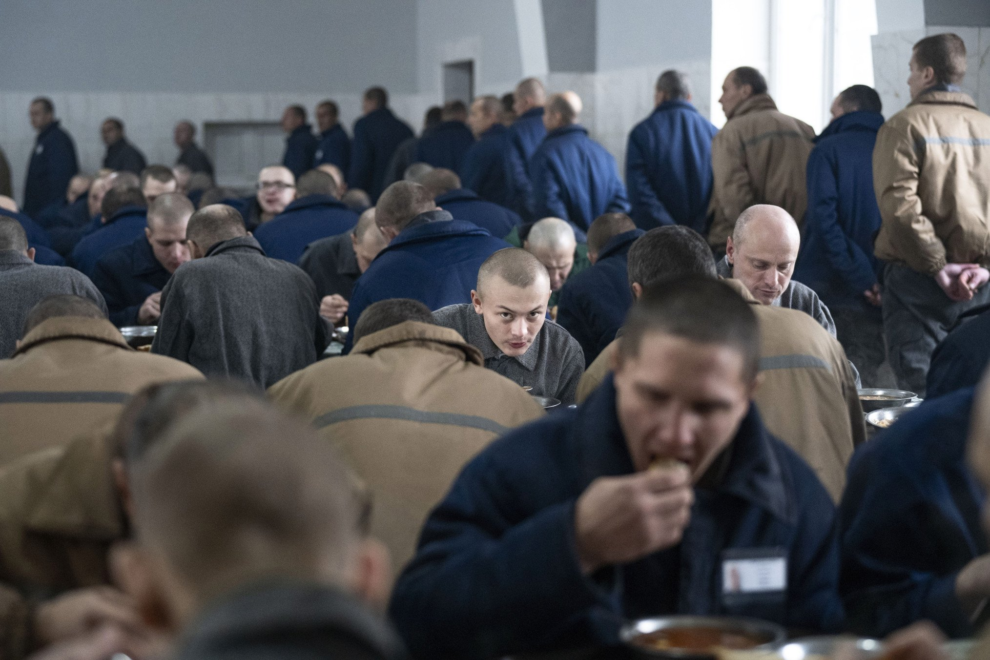
One of the clearest indicators of Russian battlefield exhaustion is the steady rise in prisoners of war. More than 10,000 Russian soldiers have been captured by Ukrainian forces since 2022—a number that would have been unthinkable during the war’s first months, when Moscow still believed its own propaganda about a collapsing Kyiv.
“Frankly speaking, they tricked us,” the officer replies, referring to his military superiors sitting in Moscow. “Everything we were told was a fake. I would tell my guys to leave Ukrainian territory. We’ve got families and children. I think 90% of us would agree to go home.”
According to data from Ukraine’s Coordination Headquarters for the Treatment of Prisoners of War, the trend is accelerating. 2025 recorded the highest number of Russian surrenders to date, with 60 to 90 troops giving up each week.
In August 2024, the number spiked dramatically: 350 Russian soldiers surrendered in a single week, a figure that stunned even seasoned Ukrainian officers. Since mid‑2023, the ratio has flipped—more Russians are being captured than Ukrainians, a reversal that speaks volumes about morale, leadership, and the widening gap between Moscow’s rhetoric and the lived reality of its troops.
Where the Captures Happen—and Why
The majority of Russian POWs were taken in the Donetsk region, especially around Pokrovsk and Bakhmut, where some of the war’s most savage fighting has occurred. Others were captured in Zaporizhzhia and even inside Russia’s own Kursk region, where Ukrainian raids and counter‑operations have exposed the fragility of Russian border defenses.
Independent polling indicates two-thirds of Russians now support peace talks, the highest level since the war began.
These are not isolated incidents. They reflect systemic problems: poor logistics that leave units undersupplied and undersupported; rotating waves of untrained conscripts thrown into complex operations; rigid command structures that punish initiative and reward blind obedience, and a widening disconnect between frontline troops and Moscow’s political leadership
For many Russian soldiers, surrender is not a betrayal—it is survival.
The Mercenary Problem: A Patchwork Army
As word filters back to Russian towns and villages—through funerals, whispered conversations, and the testimony of returning wounded—the Kremlin’s recruitment machine has sputtered. The once‑tempting enlistment bonuses no longer outweigh the risk of dying anonymously in a trench outside Avdiivka.
In response, Moscow has increasingly turned to foreign mercenaries, recruiting from Europe, Asia, and Africa. The result is a patchwork army with wildly uneven training, incompatible languages, and clashing expectations.
The dark joke circulating among Ukrainian soldiers—“Dead North Koreans nod silently in agreement”—captures the absurdity and tragedy of this multinational improvisation.
In 2025, Ukrainian authorities reported that 7% of all captured Russian fighters were foreign nationals, representing 40 different countries. Each week, 2–3 foreign mercenaries surrender, often bewildered, disillusioned, and eager to explain how they ended up fighting someone else’s war.
Azov’s International Battalion and the Battle for Zolotyi Kolodiaz
One of the most striking episodes occurred during the clearing of Zolotyi Kolodiaz, a village near Dobropillia in Donetsk Oblast. In a single 24‑hour period, Ukraine’s Azov International Battalion—a unit formed in late 2024 under the National Guard’s 12th Special Forces Brigade—captured 18 Russian soldiers, roughly the size of a full platoon.
This was not a minor skirmish.
In August 2025, Russian forces launched a deep penetration operation, pushing 15 kilometers into Ukrainian‑held territory in a matter of days. The breakthrough forced Kyiv to redeploy elite units, including the 1st Azov Corps, to stabilize the front.
The Russian advance soon bogged down. Their troops dug into the villages they had seized, creating a patchwork of fortified positions that required months of painstaking clearing. Zolotyi Kolodiaz, one of the deepest points of the Russian incursion, became a symbol of both the audacity of the initial push and the futility of its aftermath.
By December 2025, after four months of counterattacks, the village was fully retaken. The Azov International Battalion’s role—foreign volunteers fighting to expel foreign invaders—was not lost on Ukrainian or international observers.
A War of Diminishing Returns
The rising number of Russian POWs is not merely a statistic. It is a barometer of a military campaign that has lost coherence, momentum, and moral authority.
For the Kremlin, the war has become a self‑perpetuating cycle: More losses → more mobilization → more resentment → more surrenders
Meanwhile, 81% of Russians say the Ukrainian side has had no intention of reaching an agreement in Istanbul (15% disagree). Thus, the war must go on.
For Ukrainian forces, each surrender is both a tactical gain and a psychological victory, reinforcing the sense that time—and history—is not on Moscow’s side.
The war grinds on, but the trend is unmistakable: More Russian soldiers are choosing captivity over loyalty to a war they no longer believe in.