“They Want Us to Surrender”: Kyiv Residents Endure Freezing Cold After Attacks on Civilian Infrastructure.
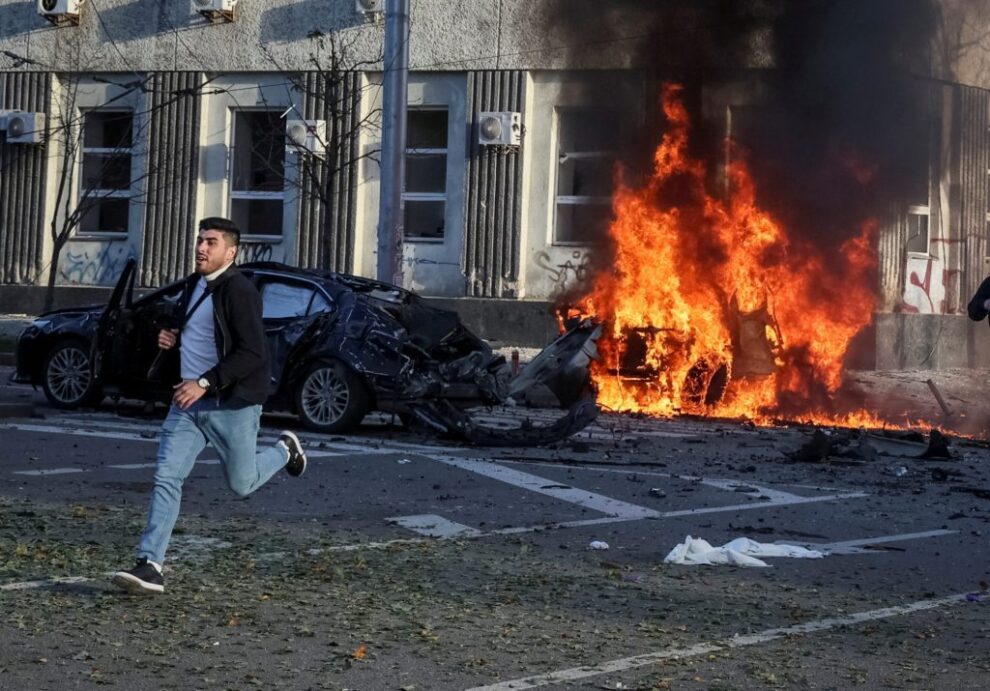
Russian missile and drone strikes plunged large parts of Kyiv into darkness and freezing cold overnight on January 15, leaving thousands without electricity, heating, or water as temperatures fell far below zero. As emergency outages stretched into days, residents improvised to survive—while rejecting the idea that terror from the air would force them to surrender.
Kyiv, like German cities during the Second World War, is being subjected to a deliberate campaign of aerial terror. The Kremlin can no longer plausibly claim military necessity or progress in a war of attrition. What remains is a War of punishment and revenge.
Like Leningrad the onslaught of missiles, rockets and absence of heat and water punishes the civilian population. The small and elderly are often the victims. The suffering is known to Vladimir Putin. Leningrad withstood the German terror. Lenigrad the country’s second largest city, was besieged by Germany and Finland for 872 days, but never captured. Neither was Kyiv.
It was not classified as a war crime at the time, but since then, some historians have classified the regimes attack against the Kyiev as a genocide due to the intentional destruction of the city and the systematic starvation of its civilian population.
Millions across Ukraine are left without heat or power in winter temperatures dropping to −25°C (−13°F). There is no military justification for targeting energy infrastructure serving civilians. Children, the elderly, and families are bearing the brunt. Moscow’s narrative of “brotherly love” has collapsed under the weight of its missiles. People seek shelter in a Kyiv metro station as a Russian airstrike hits the city, in the early hours of February 3, 2026 the energy grid has effectively become the “Fourth Front”.
“Welcome to the medieval ages”
In central Kyiv, Eline, a logistics manager, sat in her dark kitchen illuminated only by candles and the blue flame of her gas stove. Her old apartment, with four-meter-high ceilings, became uninhabitable after electricity failed to return on January 14.“My flat is freezing,” she said. Without power, her boiler stopped working, leaving only cold water. “You cannot wash yourself with cold water if it’s already cold. You cannot warm up.”She had not showered in two days and slept fully dressed to conserve heat.“I haven’t taken off these clothes since yesterday,” she said. “It was so freezing that I realized I couldn’t undress and change into pajamas.”To cope, Eline layered wool socks, tights, insulated trousers, sweaters, and coats indoors. At one point, she considered moving her bedding into the kitchen—the warmest room in the apartment.“Welcome to the medieval ages,” she said with a bitter laugh.
Following repeated strikes on critical infrastructure beginning January 9, Kyiv Mayor Vitali Klitschko urged residents to temporarily evacuate the capital for areas with independent heating systems. For many, leaving is impossible.
“Some need to work, and some need to stay here,” Eline said, adding she worried most about families with infants. “I cannot imagine how I would cope with a one-month-old baby in these circumstances.”
Despite the hardship, she rejected the notion that Ukrainians would give in.
“They want us to surrender,” she said. “But most people understand that if we surrender, it won’t become better.”
“Points of Invincibility”
Across the city, residents sought refuge in municipal warming tents powered by generators—known as “Points of Invincibility”—where they could drink hot tea, charge phones, and escape the cold.
In Kyiv’s Troieshchyna district, Oksana, a manager, sat inside one such tent with her eight-year-old son. Repeated attacks had caused prolonged outages.
“They were giving us electricity little by little,” she said. “Then after another strike, the power went out again for a long time. Over the past thirty hours, we had electricity for only about two hours at night.”
Her son played on a tablet as generators roared outside. “He’s gotten used to it,” she said. “This is the life he’s living. For him, it feels normal—even though he understands what’s happening.”
Inside another tent, seven-year-old Mia drew pictures and played with modeling clay alongside her sister, listening to the distant rumble of explosions and the wail of ambulances.
“It was a bit scary,” she said quietly. “It was very loud—bang, bang, bang.”
For Kyiv’s children, this has become another night of war.
Targeting civilian infrastructure
The outages followed several days of Russian missile and drone strikes across Ukraine. The Ukrainian Air Force reported that Russia launched at least 82 Shahed-type drones in a 24-hour period, including newer, rocket-powered variants. Some targeted a thermal power plant in Kyiv, according to local monitoring channels.
Mayor Klitschko said approximately 300 apartment buildings in the capital remained without heating as of January 15. Emergency blackout schedules were still in effect, with no stable timetable for restoring power.
Energy Minister Denys Shmyhal said a special coordination штаб had been established to stabilize energy and heat supply. Ukraine’s Security Service (SBU) said it had gathered evidence indicating that Russia’s strikes on energy infrastructure form part of a systematic campaign targeting civilians—acts it said amount to crimes against humanity.
Freezing temperatures further complicated repairs as energy workers raced to restore damaged systems amid continued attacks.
Terror that backfires
The Kremlin justifies its campaign as an attempt to break the Ukrainian government by punishing the population. But the strategy is backfiring. Ukrainians are exhausted—without doubt—but surrender is no longer a credible outcome.
The war has entered its fourth year, with devastating consequences for civilians. Heat, water, shelter are like Leningrad under siege.
In retaliation, Ukrainian forces carried out overnight strikes against Russian military targets in eastern and southern Ukraine, hitting ammunition depots and command posts, according to Ukraine’s General Staff.
Meanwhile, Russian battlefield losses have increased sharply in recent weeks, raising questions about the Kremlin’s ability to sustain its manpower without another mobilization.