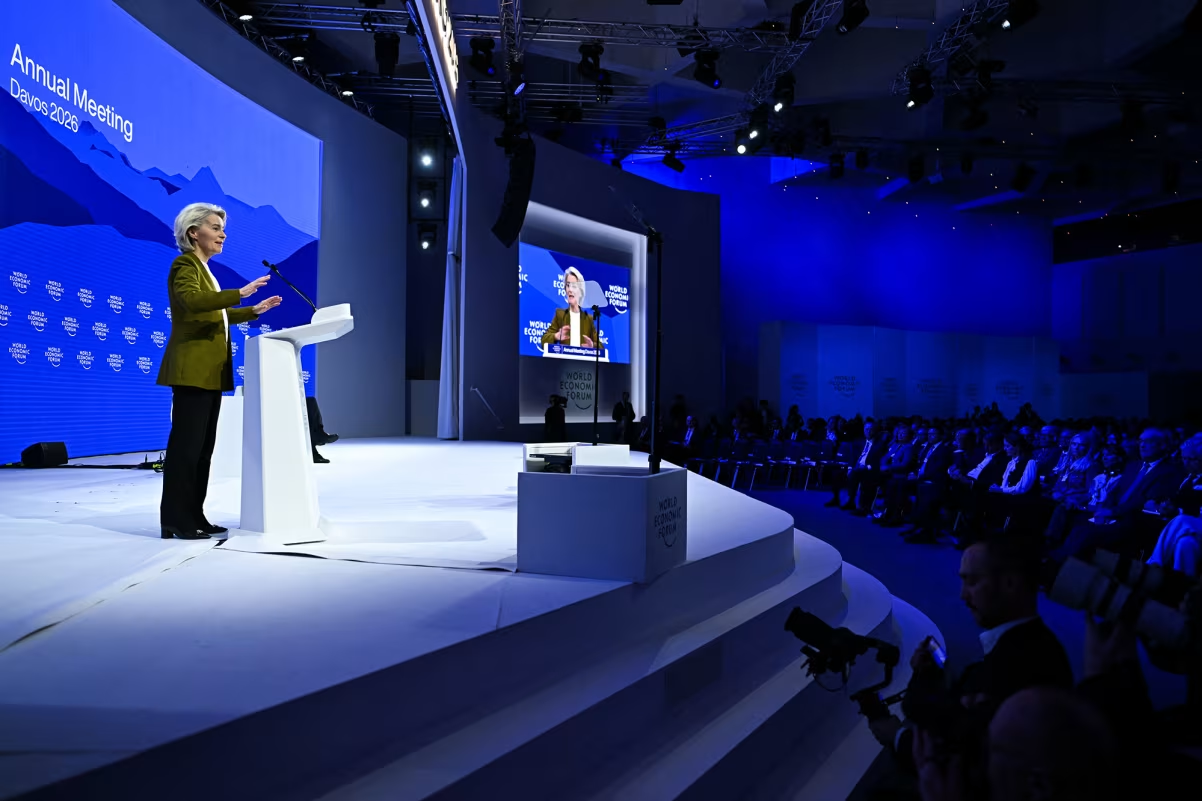
In a speech at the World Economic Forum last month, Ursula von der Leyen, head of the European Union’s executive body, repeatedly stressed the bloc’s need for “independence.”
She was speaking against a backdrop of threats by US President Donald Trump to either invade or extort the sale of Greenland – a sovereign territory of Denmark – and punish with tariffs several European countries opposing his plans. It was a watershed for a region that has traditionally opted for cautious diplomacy over confrontation with the White House.
Trump’s threats may have evaporated, but the feeling in Europe that it should become less dependent on the United States for its trade, its energy and its technology, has not. However, loosening those connections would be extremely difficult and come with enormous costs, analysts told CNN.
“You’d be trying to unravel and unpack several centuries of ever-deepening social, historical, institutional, economic, financial ties,” said Neil Shearing, group chief economist at Capital Economics.
Still, Europe cannot afford complacency as it faces the prospect that Washington’s volatile, winner-takes-all approach to its allies may outlast Trump – and that its dependencies on the United States could become its vulnerabilities.
“I think there’s a kind of fundamental element of distrust now, or concern about what might come (after Trump),” Shearing said.
But the outsized role played by the United States in Europe’s economy would make a hard split unrealistic and potentially ruinous for the region as it currently stands. Here’s why.
Trade
Deepening trade ties with other countries is an important way Europe could become less reliant on the United States. Already this year, the EU has inked trade agreements with India and four South American countries – a bloc referred to as Mercosur – after decades of negotiations.
Carsten Brzeski, global head of macro research at ING, said the deals appear to be a step toward decoupling from Washington but that “neither Mercosur nor India will be able in the next decade to take over the role… that the US holds in European trade.”
According to the EU Council, the EU and US have the largest bilateral trade and investment relationship in the world. The value of goods and services exchanged between them topped €1.68 trillion ($2 trillion) in 2024, representing almost 30% of the global total.

The United States is also the biggest export market for EU goods, which include cars and pharmaceutical products, the Council said. Germany – the bloc’s largest economy and a major exporter of autos – likewise counts the US as its top trading partner.
Yet Europe needs the US far more that it is needed by Washington, said Brzeski. “Europe has always been export-oriented. Europe doesn’t have enough (of its) own resources,” while the United States generally has a more “insulated, autonomous” economy, he added.
Technology
Europe lacks the kind of mega tech companies that abound in the US, making it reliant on American firms for its digital services.
“The internet in Europe is essentially a US construct, a US system. And Europe doesn’t really have a competitor to any of that,” said Shearing at Capital Economics.
The bloc’s most valuable tech firm, Dutch chipmaker ASML, has a market capitalization roughly three times smaller than Tesla, the least valuable of the US’s so-called Magnificent Seven – a group of tech giants whose performance has recently driven the US stock market.
French Prime Minister Sebastien Lecornu said last week that government officials will ditch Zoom and other US-owned video conferencing tools and begin using French-owned software. The decision is intended partly to reduce “dependencies on non-European actors,” Lecornu wrote in a letter to ministers shared by a minister on X.
Brzeski at ING said Europe would need to invest enormous sums to catch up with US providers of digital services, cloud infrastructure and data centers. “So, bluntly, (it needs) to have a kind of European version of (the Magnificent) Seven,” he said.
Energy
Europe is still untangling itself from its long-held reliance on Russian oil and natural gas flows – a dependence that became a strategic weakness following Moscow’s full-scale assault on Ukraine in 2022.
The bloc ramped up imports of liquefied natural gas from the United States to plug the hole left by Russian supplies, leaving it less vulnerable to Moscow’s weaponization of its energy. Russia was the EU’s top supplier before the war, accounting for 40% of its gas demand.
But Trump’s habit of weaponizing US trade by imposing tariffs to extract concessions from allies has changed the risk calculus. The president has already used energy as leverage in trade negotiations with the EU, winning a commitment from Brussels last summer to buy $750 billion worth of US energy products.

American LNG imports accounted for almost a quarter of the EU’s gas demand last year, up from 6% in 2021, according to data from Wood Mackenzie.
“It’s obviously not a dependency similar to the one Europe had with Russia… but it’s still a considerable dependence,” Massimo Di Odoardo, vice president of gas and LNG research at Wood Mackenzie, told CNN.
Still, the share of American LNG in the European energy mix is expected to increase over the next few years as domestic gas production in Norway – currently the bloc’s largest supplier – declines, according to Di Odoardo.
But truly weaponizing US energy would require the participation of private US companies, he added. These firms are bound to long-term supply contracts with European buyers, with legal and financial interests to fulfill their terms.
Unlike gas transported via pipelines, however, LNG from one supplier can be easily swapped with that from another. “It’s a wise policy to diversify supply rather than being reliant on any single supplier… (it) is what every sensible government should be doing,” said Di Odoardo.